Showing posts with label overdyed fabric. Show all posts

Monday, October 19, 2015

Overdyeing experiments - part 3 - some fabric pics at last

My goal in overdyeing fabric was to create more nuanced colors which I would like to explore further in various ways. I am mostly drawn to clear bright colors, so this wasn't an exercise in exploring neutrals. However, there is definitely a place for more subtle colors and neutrals. Helen Terry has some great posts on neutrals overdyeing experiments with complementary colors, and she has some truly lovely results.

My experiments are not rocket science, nor do they produce startling new information, but I find it helpful to document what I find as I experiment with Procion MX dye, and perhaps some other new dyers will too. Here are the conclusions I drew from this exercise:

1. It's all about proportion. Mud is not a foregone conclusion whenever the 3 primaries meet. There were some complementary mixtures which made pleasing colors where the proportions were not 1:1.
Base green/overdye red = ick
Two perfectly pleasant greens (top) which become extremely ick when the overdye contained too much red (bottom). Trust me, this photo is flattering those overdyes. They are butt ugly.

2. To my taste there are more positive results when the base range is analogous to the  overdye.
Base yellow/overdye analogous = all good results
Teal and pink overdyes (bottom) are not strictly speaking analogous, but far enough from complement to produce some very pleasant colors. 

3. The overdye which was successful across the greatest range of base colors was a pure blue. Further tests needed to determine if this was because it was blue, or because it was not a mixture. All the other overdyes were mixtures of pure colors (except the dirty green, which had grey). Almost all the base colors were mixtures of pure colors.
Blue overdyed with indigo
However, even in mixtures the blue played nice. This medium blue (left) is a mixture of 4 different colors, overdyed with indigo (red and blue), on the right. The base blue makes for some lighter pops of color creating a nice varied result.

4. When working with mixtures it is really important to keep in mind what makes up the mixture in order to have a successful overdye. Green made from blue and yellow will introduce very different elements than a green made from yellow and black.
Overdye surprise!
These little pops of turquoise are not turquoise dye, but blue overdye reacting with the  yellow which separated out in the red mixture. The result makes for some stunning pops of unexpected contrast.

5. Grey is a whole other ball game. There is a new pure grey that has just been manufactured, but this isn't it. This is a grey that tends to green. That means it is great with the blues and greens and teals, but turns pinks and purples a dull brownish mauve. From left to right, orange and grey - an interesting mushroom; teal and grey - never met a teal I didn't like; red and grey - unappetizing brownish mauve. Looking forward to testing with the new grey to be able to grey things without adding unintentional elements into the mix.


Grey overdyed
6. Overdyeing can rescue an obnoxious base color. Here the base color was a lime that would set your teeth on edge (bottom). Overdyed with teal (top), it becomes a much more likeable sour apple green, still with hints of lime to give it interest.
Lime green overdyed with teal
7. The respective strength of the base color and the overdye will have a big influence on the results. I dyed the base color at 4% OWG (left) and at 8% OWG (right). The overdye was at around 2% OWG. Remember the covalent bonds? An 8% dyestock uses up a lot of the available dye sites on the fabric, so the overdye was much less obvious. Some of the overdyes were made to a much weaker concentration than others. I was afraid the indigo would overwhelm if I made it too strong. The pink and dirty green were also very dilute. Where these overdyes were layered over colors similar to themselves, they barely registered.


On the 4% piece (left) you can see the mottled look created by dye sites which are not completely full. This is particularly obvious when you dye with the low water immersion method. This red was overdyed with a dilute dirty green made of yellow and grey. On the 8% sample there are barely any overdye marks (bottom right). On the 4% sample there are some interesting greeny/grey marks (bottom left).

Even more dramatic is the indigo overdye.
The 4% solution (left) allows for a strong indigo overtone in the overdye (bottom left). On the sample dyed at 8% (right) there are only traces of indigo by itself in the overdye (bottom right), although the base color has darkened considerably. 

One last point is the fabric used. Because I planned to dye so much, I went cheap and used my Joann's coupon to buy the Premium Legacy muslin. This is not mercerized, and gets a fuzzy look after a tough dye workout. If I had used mercerized print cloth, I would have had brighter results.

Lots more questions to answer! To the dye pots for more experiments!!

Wednesday, October 14, 2015

Procion MX overdye results - part 2 - Excel-ish

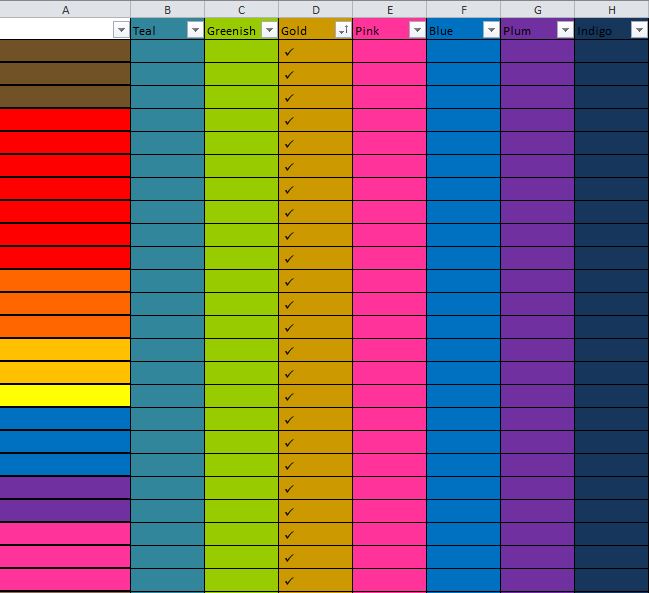
So this may look complicated, but it isn't really. Column A represents the family of the base color, red, yellow, orange, etc. Columns B though H below represent the overdyes used: teal, dirty green, gold, pink, blue, purple and indigo. The check marks represent the overdyed colors I liked enough to want to explore further. This was a somewhat depressingly small pile compared to the mountain of originals! But I was very picky. A lot of the colors were perfectly nice, just not "wow".

The first check mark below in cell B2 is a red base color overdyed with teal; the second check mark in cell B3 is an orange base color overdyed with teal; the third check mark in cell B4 is a yellow base overdyed with teal, etc. etc. Each base color had been washed out fully and then re-soda soaked, so the results don't reflect wet colors mixing, but a true overdye of a previously completed dye job, utilizing the transparency of Procion MX dyes to create interesting new colors.


According to color theory, red and yellow and blue make brown. Some browns are delightful. Some are not. The more you overdye, the more chance of sludge, or the technical term, "ick". However, color is a very subjective thing, and the colors that stood out for me in this exercise might not appeal to others. Disclaimer: I am not fond of plum and I am very fond of blues and teals. This probably skewed my results below.

Teal overdye results
Teal is a mixture of yellow and turquoise. As expected, where the teal overdye hits a base color with a high proportion of red, ick ensues. Very few red and orange colors made the cut below. Yellows also pushed the teal too far to green for my taste. Pinks and purples, being made up of less red, created some pleasant colors. Lots of analogous hits. 
Teal overdye
Dirty green overdye results
The results were a complete surprise. I did not expect to have so many hits with red with a green overdye, but I had forgotten that this green had no blue in it. It was a yellow/black mixture. No blue meant no ick.
Green overdye
 Gold overdye results
Clearly the gold did not play nice with the greens, or else I only like a very specific kind of bright happy green, not so much the sludgy/khaki/camo. The gold had red in it. Go figure!


Gold overdye
 Pink overdye results
The pink was heavily diluted and so often failed to make much impact on the reds or purples and it was quite unpleasant with the browns. Pink is a watered down version of red and yellow so very limited green hits below as might be expected. My grey had green in it, so more ick ensued with pink overdye there too.
Pink overdye
Blue overdye results
Blues are real team players. Probably the best range of good results across the other colors. This was a pure color overdye, so nothing to split, unlike all the others. And such good across the board results, hmmm. Something to ponder there. More experimentation required!
Blue overdye
 Plum overdye results
Well goodbye yellow! And brown..And green...The plum was a mixture of red and blue, so any base color with a large proportion of yellow in the mix tipped it right into ick territory. Lots of positive orange results where the concentration of yellow wasn't so strong.

Plum overdye
Indigo overdye results
Again, indigo is a blue/red mixture, so the yellows don't play nice, but the oranges are not too bad, and the depth of the indigo makes it stand out well against the blues.
Indigo overdye
Excel is a hugely powerful program, great for tracking and analyzing dye experiments. Maybe in the future I will do a post on using Excel. 

In the next post I will show some fabric samples and try to draw some conclusions.